

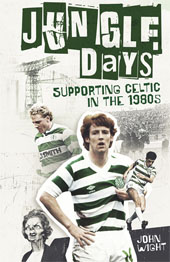
Jungle Days: Supporting Celtic in the 1980s (Pitch Publishing, 2025), by John Wight
Jungle Days: Supporting Celtic in the 1980s by John Wight does what it says in its title. The book chronicles his support of the Bhoys in the one of the most turbulent decades of the twentieth century. Yet the tome delivers far more, giving a superb history of Celtic and its importance to the Irish in Scotland. Wight, a lifelong Celtic fan from Edinburgh, begins his story the 1979-80 season with Celtic beating Rangers 1-0 in the Cup Final and the infamous Hampden riot after the game. His writing captures the eighties with astute insights into football and Thatcherism during the decade.
Jungle Days evokes to the mood of the time from the viewpoint of a fan on a supporter’s bus travelling to the games from outside Glasgow. The drink and the characters flow from the book’s pages with the eighties music of Frankie Goes to Hollywood and U2 providing the soundtrack to the bus journeys to Paradise. In each chapter the author also gives a team sheet for iconic games. Who cannot smile when you read the names club legends such as Charlie Nicolas, Frank McAvennie, or Paul McStay? But Wight also mentions lesser-known Celtic players that most of us have forgotten or have tried to forget. Asking us: “Today who remembers the likes of Mark Reid and Pierce O’Leary?” His diligence in chronicling uncelebrated players is one that demonstrates the deep knowledge of a committed supporter.
As well as players giving a sense of the era, he is also able to capture the collective supporter memories of great Celtic days. One celebrated day was the 3rd of May 1986, when Celtic won the league at Saint Mirren Park in the final eight minutes of the season. When reading his account, we are back on the open terraces, as the news filtered through transistor radios of Albert Kidd scoring a brace for Dundee against Hearts at Dens Park. The pandemonium and pitch invasion in Paisley are all there in these pages.
Wight blends memories of a supporter with an insightful historical analysis of why Celtic is so important to the Irish of Scotland. His accessible history of the club and its origins is superb because it accurately describes how Irish immigrants were discriminated to such an extent in Scotland. In response as a community, the Irish established their own parallel social structures. This included setting up institutions such as Catholic education, charities like Saint Vincent de Paul, sporting organisations such as Celtic and how the club was central in the formation and promotion Irish identity in Scotland.
Whilst Wight is impassioned in his writing of the history of Celtic, he nevertheless, pulls no punches in his account of the historical tensions within the club. He specifically focuses on acrimony between the Board and the support during the eighties. Observing that by the 1980s the founding spirit of Brother Walfrid’s charitable cause was replaced by business self-interest and these financial considerations being the paramount concern of the Board. He observes, in decade of Thatcherism, the Board viewed the support as: “customers rather than custodians. Capitalism in the boardroom: solidarity on the terraces.” Wight adeptly makes parallels between the eighties with the contemporary dynamics between Green Brigade and current Board. The author astutely comments that the more things change the more things seem to stay the same.
Jungle Days is essential reading for anyone who wants a good insight into what it was like to support of Celtic during the turbulent decade that was the 1980s. However, the book is much more than just a fan reminiscing about the era. It gives a superb historical account of why Celtic Football Club is an important institution for the Irish in Scotland. He observes that: “Out of this history derived a concrete set of values that succeeding generations of Celtic fans have embraced, upheld represented and carried with pride.” This is a supporter’s book written from the heart, but also with a clear mind of a fan who understands that: “And if you know your history” is not a cliché but a mantra to be lived by Celtic supporters.
Reviewer: Dr David McKinstry
Dr David McKinstry is a teacher and poet whose work is widely published and broadcast across Ireland and in the UK. Contact details: davmick38h@yahoo.co.uk
 ntvcelticfanzine.com