

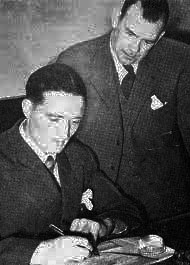
Philip Vine in his book ‘Immortals’ looks back at the return to the club of one of its most famous sons.
“Morning Boss,” Stein said.
It was Tuesday, 9 March 1965 when Stein limped through the doors of Paradise as manager of Celtic, and he immediately sought out Jimmy McGrory, ousted by Kelly and about to begin his stint as public relations officer.
Until the day McGrory died in October 1982 Stein continued to call him ‘Boss’. It was a measure of the man that with McGrory he remained unstinting in his humility and generosity.
The Celtic players, too, even those who had never played under McGrory, referred to Celtic’s legendary goalscorer and former manager reverentially as ‘Old Boss’.
Jimmy McGrory, Celtic’s record scorer with 522 goals, might have been resentful about the arrival of this brash usurper whose abilities as a footballer were ordinary at best. Instead, McGrory, when told by Kelly of his changed role within the football club, said, ‘Jock Stein is a remarkable man and a man who will give his all for the club, as he has done in the past as player and coach. He has qualities of dedication and determination. He can transform good players into great players. I don’t think there is anyone quite like him.’
At the club’s annual general meeting in August 1965, McGrory added, ‘Had I myself been the chooser of my successor, it would have been Mr Stein.’
Kelly had been worried sick about demoting his idol and replacing him with Stein, but perhaps McGrory had endured enough humiliation in a role he was unsuited to fill. Maybe, too, the constant interference by Kelly in team selections had worn him down. On away days, players waited in shabby dressing rooms with no knowledge of who would be playing and who would be dropped at the whim of the chairman. Eventually, Kelly would appear with McGrory, and sometimes an additional director or two, and they would disappear into the toilet to discuss team selections.
When Kelly had decided, McGrory’s role was to read out names scribbled presumably on hard toilet paper.
It was no way to run a team, leaving no room for tactical preparation because there was no foreknowledge of player participation.
Not that McGrory was interested in strategy and his planning for matches involved nothing but physical work without sight of a football. Since becoming Celtic manager, he had never donned a tracksuit.
To be fair to McGrory, however, this denial of the ball, in order to make players hungry for it on the Saturday, was not uncommon in the 1950s and 1960s.
Kelly said McGrory was ‘far too modest and gentlemanly to have made a real success of the job’. In view of this assessment, it beggars belief that chairman and manager shared 18 years together leading Celtic.
McGrory’s new role in public relations, which he performed with dignity until his retirement in 1979, was a far cry from his days as a marauding, buccaneering centre-forward for the Celts, when the fans sang his praises from the terracing of Paradise.
Tell me the old, old story
A hat-trick for McGrory
A victory for the Fenians
He will carry us through!
He’ll carry us through the hue
To beat the bastards in blue
Look forever to McGrory
He will carry us through
Whatever McGrory’s limitations as a manager of Celtic, Jock Stein, though, recognised an immortal when he saw one.
When Kelly released Stein from his work as reserve team and youth coach at Celtic in March 1960, he neither expected nor suspected his return as manager five years later. Nor did he anticipate Stein’s Dunfermline Athletic would defeat Celtic 2-0 in the replayed Scottish Cup Final of 1961.
Kelly, to his credit, was magnanimity personified. ‘It’s no loss what a friend gets,’ he said to reporters.
Stein had transformed his charges from a club in danger of both relegation and extinction into debut cup winners and, in the following season, to fourth place in the league and adventures on the grand European stage.
It was no surprise when Hibernian came calling in 1964 and again Stein was successful in raising both the club’s league position and profile in world football when his team defeated five-time European champions Real Madrid 2-0 in a prestige friendly. Stein was a rising star in the
firmament of football management.
It was Christmas 1964 and Kelly was wracked by indecision, by loyalties to McGrory and his assistant, Sean Fallon, and by guilt from his clandestine meetings with Stein. The Hibernian manager, too, had proved an obdurate negotiator.
Something, though, had to be done.
The new year opened with a 1-0 defeat at Ibrox Park. Ongoing indiscipline within the team saw ‘Jinky’ Johnstone sent off so Kelly, ever the high ground moralist, banned the winger from playing in the team’s subsequent match.
The very next day, a measly 13,500 fans squeezed through the turnstiles of Paradise to watch a dismal 1-1 draw with Clyde. As the second half progressed, the home team were increasingly pinned down in their own half with the visitors pressing for a winner on the icy pitch. A continuous chorus of boos and catcalls echoed about the emptying stadium and frozen feet stamped in irate disapproval on concrete terracing and the flooring of the main stand.
The final whistle may have been the moment Kelly decided to accede to Stein’s demands.
If, however, Kelly had changed his mind in the morning, indecision turned at last to decisive action following Celtic’s humbling defeat at Dundee United on the following weekend. A board meeting was called at the North British Hotel for Tuesday morning.
When the Celtic chairman finally made his move, it revealed much about the characters of both Kelly and Stein. If Kelly was stubborn, clinging to his control of all aspects of the club and duplicitous to a degree, in his secretive manoeuvres behind the backs of his board of directors, he met his manipulative match in Stein.
In the autumn of 1964, when Wolverhampton Wanderers sacked their legendary manager since 1948, Stan Cullis, who had led the Molineux club to three league titles and two FA Cups, Stein saw his opportunity and executed a masterplan with dexterity and ruthlessness.
The man from Burnbank had no interest whatsoever in moving to England or in joining a club that had informed their manager of his dismissal via a letter with his name scratched from the club stationery. Nevertheless, he contacted his old mentor, Kelly, to ask his advice about the vacancy at Wolves, about whether the chairman thought it would be a good career move for Stein.
Kelly was both galvanised into action, inviting Stein to meet him at the North British Hotel, and duped. As Stein later confessed, he had played the Wolves card in his hand like a master poker player.
When Kelly made his initial offer of the assistant manager’s role under Fallon, Stein politely declined and reminded Kelly that he was seriously minded to move to the English Midlands.
It has to be said, too, that Stein was using Hibernian, taking their wages while plotting his next career move and his own financial advancement.
Money and Stein were long-time lovers whose relationship over the years had become a tad one-sided. Stein desired money, respected money, worked damn hard for money, but still real money, serious money, money that would replace his restlessness with security, with peace, eluded him.
Money teased Stein to distraction.
He was a gambler from his earliest days. In his teens at Burnbank Cross, he was a runner and a lookout for local bookie Mick Mitchell, who ran his illegal operation with occasional police cooperation. Stein loved a bet and later in life, in Paradise, he and Fallon would spend many
an afternoon glued to the television watching the racing. Often, too, the inseparable pair would disappear to Ayr races where the size of Stein’s wagers never ceased to shock his more cautious assistant manager.
Stein could be duplicitous too. In his playing days with Albion Rovers, in 1948, when the Coatbridge side were promoted to the First Division, there was a renegotiation of players’ wages led by the team captain. Stein assured his colleagues £9 a week was the best they could hope for, and even calmed a dressing room rebellion against the new terms of employment. Stein, though, had negotiated £10 a week for himself in return for a promise to persuade others to accept less.
This is not to be overly critical of Stein. He had worked too many too long days and nights underground in the Lanarkshire mines, seeing men die for their money, to underestimate his privileged position as a football man.
He could at times be extraordinarily generous, treating money as if it were a casual lover rather than a lifetime’s romance. During World War Two, Lanarkshire miners went on strike under the influence of the young firebrand union leader Mick McGahey. Stein gave his £2-a-week wages from Albion Rovers to the strike fund so that he would be no better off than his pitmen colleagues. Later, during the national strike of 1984 and 1985, Stein could be seen cramming bank notes into miners’ collection tins.
He never forgot his origins or his debt of gratitude towards his hard-as- miners’-boot-nails upbringing. In an interview with the journalist Hugh McIlvanney, he said, ‘Everyone should go down the pit at least once to know’ what darkness is.’
It was not just the pits, however, that provided Stein with an education in life. His father, George, and his family were Protestant and Rangers diehards, and Stein himself was a fan of the Ibrox club. When the young man showed some footballing ability, a career path was mapped out by
George. Blantyre Victoria to Rangers was the plotted pathway to glory. Both teams sported the red, white and blue of Union Jack Protestant patriotism. Stein was his father’s sole son amid a dazzle of darling daughters and George’s ambitions for his boy were heightened by the knowledge that Stein provided his only chance to live his own footballing dreams.
Stein, though, signed for Burnbank Athletic, an act regarded by his father as treachery and treason. George tore up the papers and persuaded his son to sign instead for the Protestant Blantyre Vics, but that would be the last time the father imposed his will upon his son.
Whereas James Kelly had suggested that Robert give up the game of football, and found a compliant and dutiful son, George found a son of sterner, rebellious stuff.
Stein signed for Celtic in 1951 and, afterwards, his father never once wished him well. Stein’s best friend from boyhood days, too, shunned him for the rest of his life.
The Celtic manager was not a man for triviality or trappings. He was a hard man and expected and demanded his players were hard men too and, in that pursuit, he curated austerity, created hardship, mental and physical, to build strength of character.
Throughout the Stein era, the club’s training facilities were at Barrowfield, half a mile from Paradise. Players changed at the stadium and ran in all weathers down London Road to work on the spartan pitches at Barrowfield. However cold the weather, no tracksuits were permitted. Stein’s own office at Celtic Park, a short pass away from the foyer, was cramped and suitably and impressively frugal.
As for leaving Hibernian in early 1965, Stein was typically hardnosed.
He had done a fine job for the Edinburgh club, leaving them within sight of the top of the league table, even though his last two matches in charge, when Stein’s players’ minds were distracted by their manager’s impending departure, were disappointing defeats against Kilmarnock and Morton.
Still, there was sourness and bitterness inside Easter Road at his leaving, as if Hibernian had been used, if not abused, to further Stein’s ambitions. His time in Edinburgh looked for all the world like a brief affair, a dalliance.
In Hibs supporters’ minds, it brought back recollections of 19thcentury humiliations at the hands of a ruthless Glasgow upstart when Hibernian became a recruiting ground for John Glass’s Celtic.
Neither Stein nor Kelly gave their Edinburgh counterparts a backward glance.
This extract is from The Immortals by Philip Vine, a passionate love letter to Celtic FC, by turns ecstatic and distressed, angry and joyous, but always obsessed. After the disappointment in 2021 of failing to complete the fabled ten-in-a-row league titles, the author took solace in researching causes for celebration from Celtic’s proud past. His starting point was the rallying cry that ‘two nines are better than one’, and the book’s centrepieces are stories of both of Celtic’s nine-in-a-row triumphs. On his journey he discovered darkness and despair as well as derring-do and delight.
 ntvcelticfanzine.com