
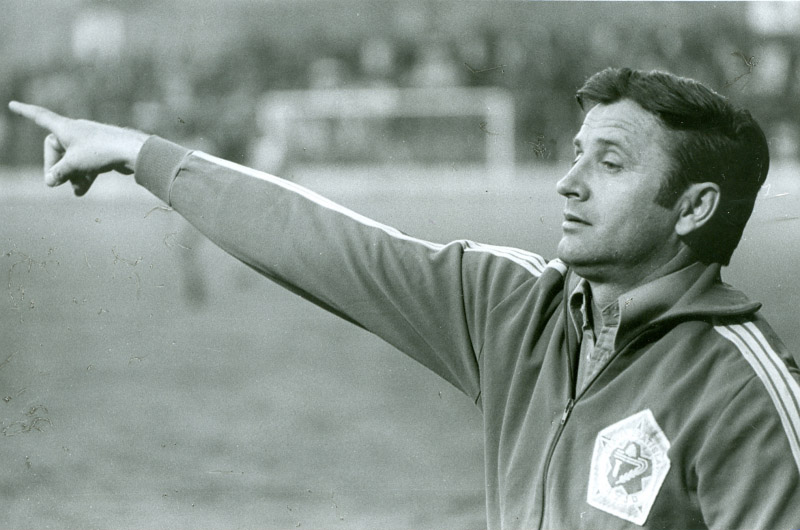
Dr Jo Venglos was appointed Celtic head coach to replace the departed Wim Jansen in July 1998. Although it was not to be a successful time during what was a turbulent period for the club, it is a measure of the man that he was held in high esteem both at the time and in later years, not least because of the players he brought to Celtic Park, including his compatriot Lubo Moravcik. This is an extract from his chapter in Graham McColl’s excellent history of Celtic managers, The Head Bhoys:
That autumn of 1998, pressure was building on Jock Brown from the press and Venglos bore the brunt of it. Disgraceful stories attacked Venglos’s character and portrayed him as a bumbling oldster out of touch with the modern game of football. The more gullible supporters who read such stories on a daily basis began to believe they contained a kernel of truth. The problems Venglos had with players recovering from injury and his short settling in period were ignored as the tabloids opened full fire on the coach.
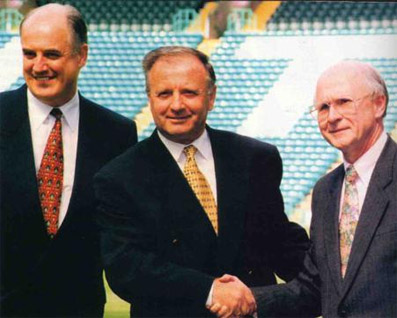
‘You know the press,’ said Venglos. ‘You have two kinds of press: constructive criticism and others
who are always thinking of other things. That was no problem. As a coach you have to live with that. I can say that I was trying to be professional in my work but some people in the press were not. I didn’t always read these things. I would read the press that produced constructive criticism. Every coach and every player needs that. When Lubo came, they did not behave nicely. They said I was his uncle and so on. It’s a pity that they didn’t know a player who had played in the World Cup and in the national team many times. They also started to speak about my English. It wasn’t fair play.’
Lubo Moravcik himself registers annoyance at the press reaction to his signing by Venglos. ‘I think the press tried to put pressure on him and me; they were suggesting things like I was his son because he had brought me to Celtic but it was never like that. He brought me in because he was thinking to do something good for Celtic – not because it would help me or help him. Whenever he did anything it was always for the benefit of the club, not for his own pleasure. The press in Scotland are always trying to create some sort of story. I was very happy that what they had said before I played was proved not to be right once I had played some games.’
The introduction of Moravcik from MSV Duisburg in November 1998 had cost Celtic a minuscule amount of money. His arrival detonated even more vicious criticisms of the club in the press
because of the size of his transfer fee – the sum bandied around in the papers was put at £350,OOO – and because Moravcik was then 33 years old.
Celtic in general and Brown and Venglos in particular were ridiculed by the press of the player’s age and because he had been purchased so cheaply. Had they known more of the truth, their criticism would have been even more fierce. Brown had negotiated the price down even lower because he had seen that the relationship between Moravcik and German club’s coach had deteriorated so badly that the player’s token transfer fee would only be a token one.
Venglos, for his part, knew that Moravcik was a master professional and that although he was in his 30s the player was in excellent condition and had a style of play that was not entirely reliant on speed and strength.
Minutes before the Slovakian made his debut, against Dundee, Jock Brown’s departure from Celtic was announced by the club. Brown had done his job professionally in pursuing Moravcik’s transfer and prior to leaving the club had been in Stockholm acquiring the signature of Johan Mjallby from AIK Stockholm.
The announcement of Moravcik’s signing had been rewarded with hysterical press vilification of Brown’s capabilities in his capacity as general manager and a few days later the press got their wish when Brown left the club; a sizeable number of supporters had been so influenced by the press that Brown knew he had to be sacrificed to appease them. The general manager had never recovered from the poor relations that had developed with the press from the beginning
of his tenure at the club. He was not replaced.
Moravcik made his debut against Dundee and onlookers with a trained eye could perceive the immediate influence he had had on his team-mates as Celtic smoothed their way to a 6-1 victory.
Venglos’ methods were beginning to bear fruit. ‘I found that there were nice players and a nice organisation at Celtic,’ he says, ‘and in our matches from October we started to play quite good combination football and the supporters appreciated it. There were exceptional players at Celtic, such as Lambert and Larsson, and we began to show what we could do, in combination, as a team. Lubo came and after one or two games everything was OK’
Moravcik had been rusting in a rut at MSV Duisburg; the coach Heinrich Fink was making him play as a holding midfielder in front of the back four. Now, at Celtic Park, he was reunited with a coach
who understood his qualities and the player was free to prompt and probe from an advanced attacking position.
A fortnight after his Celtic debut, Moravcik took the field for a Celtic v Rangers match. Johan Mjallby, the Swedish international centre-back signed by Dr Jo from AIK Stockholm for £1.5 million, made his debut in that match.
Venglos decided to field Larsson and Venglos’ fellow Slovakian as Celtic’s attacking duo. The coach’s tactics worked perfectly: Larsson was pushed on to the Rangers back line with Moravcik in a withdrawn role, floating in the area between the front of midfield and the penalty area. It meant that the Rangers central defenders were constantly torn between holding their positions in central defence or moving out to try to clamp down on Moravcik’s mercurial talents. Whenever the Rangers men stayed static, Moravcik had much space in which to work; when they came out, they were pulled out of position and left glaring gaps in their defence.
The result was a 5-1 victory for Celtic, in which Larsson and Moravcik each scored twice.
It was Celtic’s biggest winning margin against Rangers since the mid-1960s and the days of Jock Stein.
‘You have to play football as a team,’ states Moravcik, whose introduction to the Celtic team had given the players the confidence that they now had a special individual alongside them, one who could unlock any opposition system or tactical plan. ‘You can’t play attacking football if you don’t have the players for attacking football but if you’ve got attacking players you make sure you use them in the best way you can. In football, someone has to recover the ball, someone has to defend, someone has to attack, and Doctor Venglos always has good attacking players in his team. I think he’s also intelligent enough to have in his team the type of players who will run after the ball to get it for the team. He knew that he had got good players in midfield and that he also needed one player who could do something different. That is why he brought me: because my quality was maybe something different from the quality of Paul Lambert or Phil O’Donnell or maybe Burley. He brought me because he knew that with me alongside them we could make a very good team. He always looked for players who would complement each other and do a job for each other.’
Subtlety permeated Venglos’ approach to coaching. ‘He doesn’t have to shout,‘ says Moravcik. ‘Through his work with players, they can see immediately that he is doing the right things. Naturally, that means that players respect him. He is very intelligent and is good at explaining what he expects from the players. Players understand immediately what he requires from them. He is a gentleman and a good man who respects everyone and who helps his players. Players try to give him back what he gives to them. I had had three years’ experience of working with him in the Czechoslovakian team and, when I came to Celtic, it was really a pleasure to work with him every day; it was a rich experience for me. It only confirmed to me how good he was as a coach. In Slovakia he was named Coach of the Century, our best coach ever. I think that means something.’
That victory over Rangers, on 21 November 1998, sparked off a 20-match sequence in which Celtic lost just once. The players were receptive to Dr Jo’s ideas and the resultant football was, at times,
breathtaking in its expansiveness. Even an injury to Moravcik in February 1999 at Motherwell, which ruled the Slovakian out for the remaining crucial League matches that season, failed to halt Celtic’s
progress and they stayed hot on Rangers’ trail.
‘If you are missing top players,’ says Venglos, ‘and that season we were missing many top players, it’s difficult to maintain the balance within the team because you are giving a chance to young players. After two or three months the players were responding to me with a beautiful passing game that was attractive to the supporters.’
Venglos stressed to the players in training that when they played the ball forward their first thought should be a forward movement, as a third party to the move, to support the ball or run off the ball. Players were encouraged to train in small groupings of three and four and to think in terms of playing in groups of three and four on the field during a match. That way they would be supporting each other in mini-groupings on the pitch as they moved forward. It was a very modern idea and highly relevant to the way in which modern football is played by top international sides, where players go forward in units in close support of one another. Venglos’ aim was to rehearse these
things in training so often that players would automatically carry them out in matches. The players were initially puzzled by some of Dr Jo’s methods but they quickly started to respond and started to think automatically that as soon as they passed the ball they would need to make a forward movement to support the team-mate in possession. Such plans worked best when the players were playing one-touch football and as the season progressed it was possible to see
a very impressive style of passing play evolving.
An atmosphere of calm was generated by Venglos in advance of a match. He would privately ponder his plans for each game, sometimes over a glass of wine, in the confines of his flat in Glasgow’s West End, mulling over the permutations available to him as if he was tackling a game of chess in a Bratislava cafe. Having chosen his options, Dr J 0 would then give his team talk approximately an hour and a half before the game, sometimes in the team hotel. He would always be in and around the dressing-room before kick-off although he would go out for a short while before returning to speak to the players briefly before they took the field.
At half-time he would be very calm and precise in telling them what he wanted changed. He was almost serene and was never a bawler or a shouter. He would always put his ideas across to the players in a decent manner.
‘He was tactically very astute, a very intelligent man,’ states Eric Black. ‘I remember one incident in a Celtic-Rangers game where he put Simon Donnelly on as a man-marker on Barry Ferguson, which worked. Simon played from midfield and then when we won the ball he was in a position to go and cause problems. It was the first time I had ever thought of anything like that; putting an offensive player on somebody to man-mark them. Normally you would put a defensive player on a creative player to try and stop them playing. We had a creative player performing a dual role, which was something I had never considered before, I must admit. It was great to see. There is no doubt he was ahead of his time. He was excellent tactically and on physical conditioning: he would take into consideration such things as how a player’s nervous system and motor system worked when they were on the pitch.’
A 1-0 defeat at St Johnstone in late April brought an end to Celtic’s run and left them needing to defeat Rangers in the final derby League match of the season, which took place on Sunday 2 May. On a wild night at Celtic Park, Stephane Mahe was dismissed, somewhat harshly, by referee Hugh Dallas and a disputed award of a penalty two minutes before half-time put Rangers 2- 0 up at the break. Rangers added another goal in the second half for a victory that enabled them to clinch the 1998-99 Premier League title.
It was misleading to seize on those dying days of the season as the reason for Celtic failing to win the title; the most serious damage had been done early on in the season through the handicaps set in Venglos’ way during the weeks immediately after his arrival at the club. Most significantly, his late appointment as manager had the knock-on effect of his signings arriving at the club only once the season was well underway rather than before it began, as would have been the case had he been given some breathing space prior to the season.
Mark Viduka, whom he had signed from Croatia Zagreb in early 1999, had signed and subsequently disappeared, going walkabout in Australia when his goalscoring ability was required at Celtic Park, in another unfortunate episode for Venglos. That was the latest in a series of interminable delays that had stalled the introduction of Viduka until February after Doctor Jo had, in August 1998, initially identified him as the striker he required.
When Viduka did arrive he was still not fully fit, which meant that Celtic had spent the opening six months of the season with only one outright first-team striker, Henrik Larsson. Such a situation would have been a major handicap to any manager and his team. Venglos’ major signings – Mjallby, Viduka and Moravcik – each in their different ways proved to be excellent ones for the club. ‘It was probably as good a standard of football as I have seen at Celtic,’ says Eric Black as he thinks back to that time. ‘He hardly had any money at all to try and build a team and the players he did buy proved they were top buys. Given another year or two I don’t doubt that he would have been a very successful Celtic manager. He didn’t win anything but that was a lot to do with certain circumstances: he was trying to build a team and that can’t be done immediately. I felt, looking at the way the team was playing, that there were a lot of positive signs. I would have liked to have seen him carrying on, bringing in one or two players and allowing things to develop.’
Moravcik comments, ‘He didn’t really have an easy situation when he came. I don’t know why Jansen left but it was really strange because after a successful season he left and Doctor Venglos came and I think most of the supporters and most of the players didn’t understand what
was happening. That made it a bit of a difficult time for him with the expectations of the job but after a couple of months – and it’s a little bit logical that he would not achieve success immediately – the team started to play very well. He brought in good players: Johan Mjallby, who is still playing; I played a long time for Celtic; another guy, Marko Viduka, was the best player in Scotland one season. He couldn’t really bring in the players immediately and because of that, success came a little bit later. With things not being easy for him at the beginning, we lost contact with Rangers but after that we played very well, I think, and we performed really well in some games. We played nice football, attacking football; players were confident and playing well.’
Venglos says of his time at Celtic, ‘It was a great privilege and a great honour for me to have been a part of the great history of this great club. I was able to work with very good players, some very top players, which they have proven, like Henrik in the World Cup, and Lambert and Lubo Moravcik. Secondly, I had the possibility to compare the organisation of the club with those I had worked at before. The club, when I left, were very nice to me and I have excellent feelings towards the Celtic supporters. I like them very much. They like football and understand it and I feel that when I was at Celtic it was a stage where I felt the club was improving during that year.’
Dr Jo signed off as manager after a dreary Old Firm Scottish Cup final. Viduka was unavailable and Moravcik was only just back from a three-month absence through injury. Neither side played well and although Celtic had a couple of chances, a dull but even game went Rangers’ way when Rod Wallace scored the only goal of the match shortly after half-time. Fergus McCann had by then quit as managing director and Allan MacDonald had taken over as chief executive, with plans to install his friend Kenny Dalglish in a new role for Celtic – director of football.
‘I knew that Kenny Dalglish was coming,’ says Venglos, ‘and that was understandable. Kenny was a great personality in the history of Celtic. He was experienced and I said, “OK it’s time for me to go.” I had no objection to going.’
Lubo Moravcik is sorry that the players were unable to obtain the best possible leaving present for Dr Jo. ‘Unfortunately, I think the League was already lost at the beginning. My one regret from that
season is that we didn’t win the Scottish Cup. I think Doctor Venglos deserved to leave with this trophy. I think he had taken the decision before the end of the season to finish after the season. He didn’t really talk to me about that but I was feeling that he had worked hard for Celtic and that he had felt the pressure. He is a guy who really takes on full responsibility for everything; he is not someone who says, “I don’t care”. For him the season was not easy but even though we were a few points behind Rangers, he never said, “Oh, it’s finished .” He was always working hard to get closer to them and he believed right up until the end that we could do that.’
A newly-created post of European Technical Advisor was offered by Celtic to Dr Jo and he maintained close links with the club through his youth academy in Slovakia. It is typical of Dr Jo’s courtesy that he sent a fax with his congratulations to Martin O’Neill when he won the League for Celtic and the doctor attended Celtic’s Champions League matches against Ajax in Amsterdam and against Juventus in Turin during the 2001-02 season. Their performances
pleased him.
Doctor Venglos remained engrossed in football and when, early in 2001 he was in Japan, lecturing on the game, J-League club JEF United Ichihara took note of his presence in the country. When
Venglos returned home to Slovakia he received a call asking him to take over as coach. With Japanese thoroughness, those calls continued for one year and eventually Venglos capitulated and agreed to give it a try. One of his first signings, in the summer of 2002, was to be Lubo Moravcik, on a free transfer from Celtic.
Lubo was pleased to discover that this time there was no one demanding a second opinion on the good doctor’s judgement.
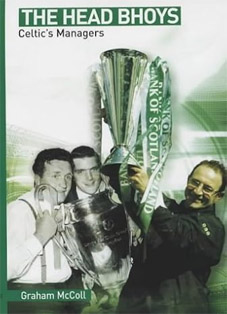
The Head Bhoys: Celtic’s Managers; by Graham McColl; Mainstream Publishing
Given the amount of dross I’ve had to wade through reviewing books for this scurrilous rag it’s hardly surprising that I have become a jaded old cynic when it comes to reading Celtic-related books. However, occasionally a book comes along which restores my enthusiasm for the task, and The Head Bhoys is one of them. Once you get past the cringeworthy title you’re into a book which is written with some style and which keeps up a cracking pace as it reviews the careers of all of the men who have at one time or other occupied Old Smokey, the Parkhead Hot Seat. I wouldn’t really disagree too much with McColl’s knowledgeable assessment of any of them.
It was not always the case that a manager at Celtic Park barely had time to get on nodding terms with the commissionaire before finding his taxi revving up in the Walfrid Car Park. In the first eighty years of the club Celtic only had five managers. They’ve made up for it since, of course, appointing eight in the last twenty years, a regularity that Corporation buses would have been proud of. All of them are given a fair hearing by McColl who takes us chronologically through the reign of each one in turn.
The first boss, Willie Maley, has his place as one of the all-time great Celts assured, of course, and it’s true that he did more than most to deserve it. McColl acknowledges these achievements but also draws attention to some of Maley’s management techniques when dealing with players (often mere boys) that jarred so much on my post-modern sensibilities that I was left with the impression of a thoroughly dislikeable individual who ran Celtic like a Dickensian Mine owner. Maley’s treatment of McGrory, for example, when he tried to get the striker to sign for Arsenal on the way home from a European trip is a perfect example of the man’s autocratic, bullying style. His treatment of the player once he made it clear that his intention was to stay at Parkhead was nothing short of scandalous: “The tawdry conclusion to his refusal to move to Arsenal was that Maley, in collusion with the Celtic board, decided that they would pay McGrory less than his due. The player, unknown to him, would receive less money than his team mates for the remainder of his Celtic career; quiet vengeance by Maley and the Celtic board of directors for McGrory’s refusal to help add to the Celtic coffers.”
His stubbornness and egocentricity eventually led to his own downfall when he had a fall-out with the directors over who was to pay the tax on a gift he had received. As McColl puts it, “The biter had been bit.”
Maley’s successors were James McStay and Jimmy McGrory, both of whom were never really allowed to get on with it without interference from above and who have become almost marginal figures in the history of the club. The directors seem to have been so pleased to get Maley out of the way that they took full advantage of having relatively pliant individuals willing to stand aside and let the likes of Robert Kelly get on with their hobby of running a football club.
Stein has been the subject of many biographies, and much of his managerial career has become the stuff of legend. There’s little new to say about the man’s achievements, but the book still manages to provide some insights into Stein as a person thanks to contributions from Billy McNeill, Davie Hay and Lou Macari. McColl also attempts to debunk some of the mythology that has grown up surrounding Stein’s eventual departure from Celtic in 1978.
As far as the history goes, the chapter on Stein is where I think the book ceases to be a straightforward – if still engrossing – chronicle and starts to incorporate all the elements of the Celtic management soap opera that we’ve become used to in recent years. There’s an immediacy about the second half of the book that really helps it fizz along.
Billy McNeill, as you might expect, is frank and honest in his assessment of his own time as manager at Celtic, and in terms of relations between manager and board, the chapter which deals with his first spell as boss clearly shows the seismic shift taking place in the game and illustrates how poorly equipped the Celtic board were to take on new challenges. McNeill had a good job at Aberdeen but when offered the post at Parkhead couldn’t take a chance on knocking it back in case it wouldn’t be offered again. The lure of Celtic was simply too strong for him, but the board chose to exploit this rather than utilise it: “I wasn’t ready. I shouldn’t have gone… It was the wrong thing to do at that particular time however exciting it was… I found great difficulty in establishing any relationship with the chairman.”
David Hay will have to go down in the annals as one of the unluckiest managers we’ve had. It’s true that there is a tendency to fall back on revisionism at times when Davie’s concerned – the last season he was in charge Celtic were often terrible – but he was up against a board of directors arguably at the height of their dizziness. His demise was another shabby affair which still reflects badly on the board. Hay was actually given permission to smash the club’s wages policy and allowed to pay a massive transfer fee for Mick McCarthy only to get the sack a week later. Go figure.
Billy McNeill returned to claim a double and was initially given some money to invest in players, but it was clear his second spell was going to have little more impact on the mind set of the board than his first. This time he was up against Holmes and Souness at Ibrox but the Celtic board had failed to evolve during the years of his absence. “The second time was absolutely desperate. It was much worse than the first time I was there because Rangers were so far in front of us.” Caesar’s plans and schemes for the future were scuppered by money problems and an outdated financial infrastructure.
By the time we get to Liam Brady the elements of high farce and low wit are all in place for a tragic-comic tale of a club spiralling out of control. Brady is naturally critical of the board, but he’s also honest enough to admit that: “If I’ve made excuses with regard to how difficult it was with the board then I have to admit that my signings didn’t really come off (one of the great understatements of all time when you remember Gary Gillespie and Tony Cascarino) and on the pitch is where I failed.” This candour is actually evident in most of the ex-managers interviewed for the book. It is a quality which undoubtedly adds to its attraction.
Lou Macari’s chapter is the briefest in the book, despite Lou’s tenure taking place at a time of huge upheaval for all concerned. As McColl says, “Returning to Celtic Park had been the biggest gamble of Lou Macari’s life and, with the odds stacked against him, it was a calculated gamble that failed spectacularly”. It ends with Fergus taking charge and Lady Cosgrove writing Lou’s Celtic epitaph at the end of the unfair dismissal hearing.
I found the chapter on Tommy Burns – Celtic’s longest serving manager of the Nineties – the most uncomfortable to read. Clearly there are still some raw wounds there. Nonetheless, there is no Bradyesque self-flagellation. He does admit that there were many occasions, through inexperience, he did the wrong thing; but to Tommy, this amounted to stuff like, “Talking back to McCann and saying things to him at board meetings.” Even then, he claims to have been driven to this course of action. No mention of getting tactics wrong or picking the wrong players.
When it comes to the career of Jo Venglos McColl is on the side of the good guys. He highlights the Doc’s credentials for being in management at the top level and rubbishes the hacks’ treatment of a much-maligned coach who did a manful job in the face of sustained hostility from many quarters.
Jansen, Barnes and O’Neill bring the story of the Head Bhoys up to date, but although its sub-title is “The Celtic Managers”, this book is as much a history of the Celtic directors. The detrimental effect they have had on Celtic over the years is made clear, and in the case of Desmond White, McColl doesn’t pull any punches: “To those who could look behind the facade at Celtic, it was clear that the chairman, Desmond White, who had succeeded Robert Kelly in 19761 was simply using the club as a licence to print money. The dedicated, captive support would fill the terraces and White would cream off the profits. Celtic have always had marvellous supporters, real lovers of football, people who live for the game. It means that if the club’s board are of a cynical bent the good faith of these people can be exploited mercilessly”.
“Everything was done on the cheap” – adds McNeill – “it was murder.”
Although a lot of board shenanigans seem so long ago now in these relatively peaceful times, there’s enough material in here to get you looking out your old pitchfork for a wistful trip up to the Walfrid Car park.
Definitely the ideal gift to put in Uncle Tim’s Christmas Celtic sock, but make sure you read it yourself first.
MANFRED LURKER
 ntvcelticfanzine.com