
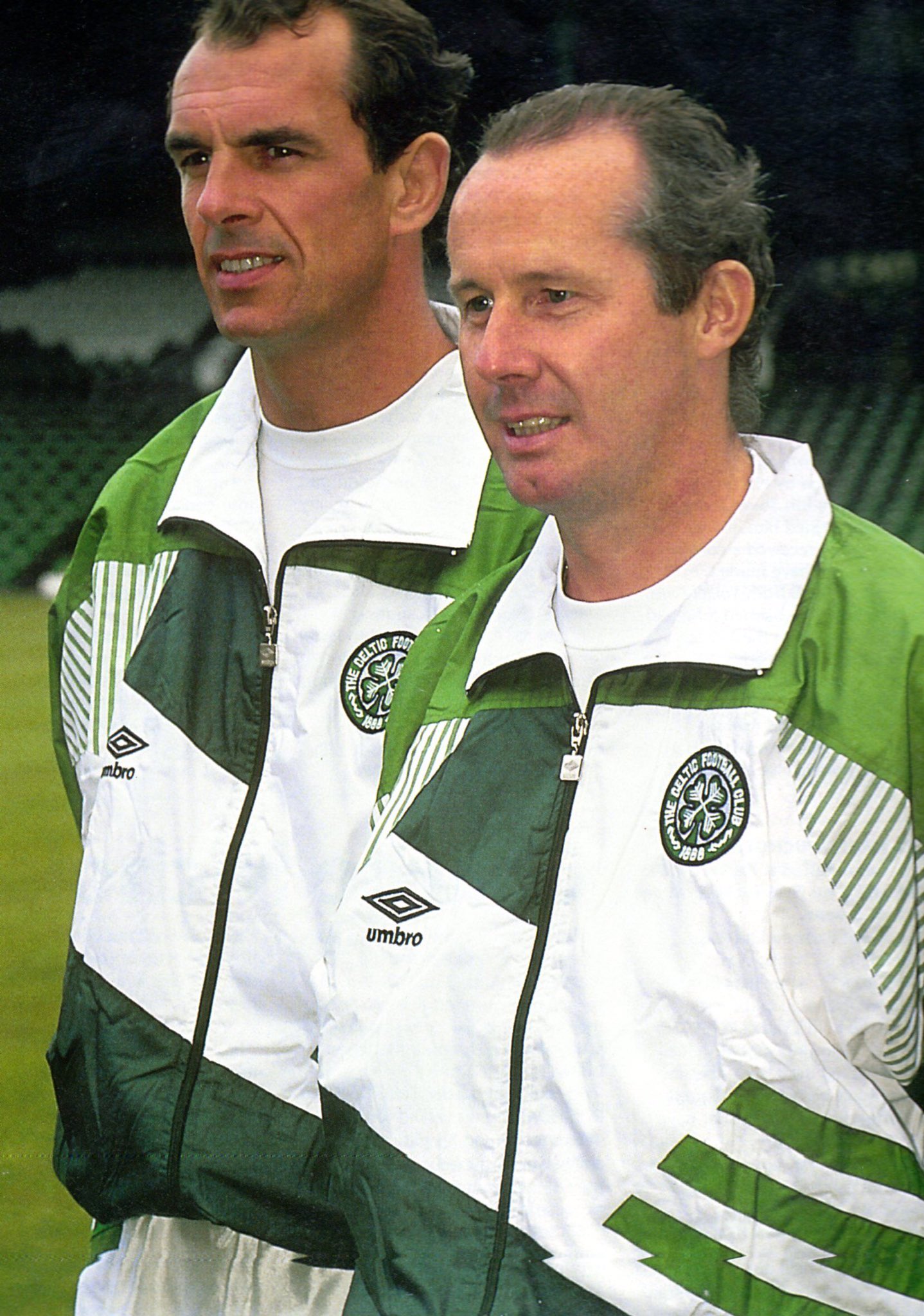
As speculation mounts over who our next manager will be we take a look back at some of the men who have occupied Old Smokey the Parkhead Hot seat over the years. We start with Liam Brady.
To paraphrase Oscar Wilde, “To lose one manager in a season is unfortunate; to lose two in the space of 24 hours is simply careless.”
Liam Brady, who during his distinguished career in Serie A was known to Juventus and Inter fans as “Liam Brady”, picked up the nickname ‘Chippy’ because of his passion lor eating chips during his young days at Highbury. Sadly for all of us, by October1993 he had had his chips as far as Celtic was concerned.
Clearly the architect who designed the facade for the main entrance at Celtic Park must have had a fair degree of foresight because Brady had become the latest in a long line of Parkhead employees who had spun through the revolving doors at the entrance to the Walfrid.
He was appointed in June 1991 in the infinite wisdom of the Celtic board of directors despite having had a managerial career that was, up until then, non existent. In an undignified public spectacle he beat off the challenge of Billy McNeill’s assistant Tommy Craig, Ivan Golac (at the time
infuriating anybody who bothered to watch Dundee United) and Frank Stapleton, a man whose credentials for the job were at least equal to Brady’s, for the chance to become Celtic manager.
The logic behind the appointment was clear enough. If the huns could achieve success with Souness then maybe Brady could do the same for Celtic, with the difference being that he would be given a fraction of the resources that Sadam Souness had to buy himself a league championship.
Alas, Brady was to prove that having had a brilliant playing career at the highest level was no guarantee that this wealth of international football experience could be translated to management.
The writing was on the wall almost immediately; inconsistency in the league was quickly followed by a League Cup defeat by Airdrie.
If we thought that Brady’s European experience might augur well lor a wee run in the UEFA Cup our illusions were soon shattered by the mighty Neuchatel Xamax (pause here while anyone who remembers this lies down in a darkened room for a wee while). The pattern for the next two seasons was already set.
Depletions to his threadbare first team squad led to several players being played out of position and even Brady’s own buys all seemed to serve their apprenticeship with a spell on one of the wings.
Some of his tactics were questionable, to say the least, and when it came to important matches the team’s bottle was notable by its absence.
But was probably for his frightening flirtations in the transfer market that he will probably be best remembered.
Boyd, Marshall and McAvennie were exceptions; the jury was still out on McGinlay and Byrne. In general though, his acquisitions were not exactly Hall of Fame material.
Cascarino arrived straight from a beach in Blackpool where he was giving rides to holidaymakers and promptly disappeared soon afterwards to torment supporters at Stamford Bridge. His most memorable contribution In a Celtic jersey was to trundle in an unmissable chance against Hearts
(which he very nearly missed) and then land a beautiful right hook on Craig Levein’s jaw five minutes later.
Having chased him all over the country for months, Stuart Slater became the most expensive signing in Celtic’s history with the promise that here was a player that would “put bums on seats”. “Ralph” certainly did that, but the seats were in local pubs all over Scotland. He too soon resumed his career in England leaving behind precious memories of his three goals, which worked out at £500,000 a strike.
Nobody was complaining when his other major purchase, Gary Gillespie, arrived at Parkhead, but it soon became apparent that while other players were receiving sponsored cars as part of their deals, our Gazza was being carried about in a company ambulance. To be fair to the player he manfully did his bit for the cause and played as well as anybody in the team, but it wasn’t long before he was giving the Celtic View lots of “fighting back to fitness in the reserves” stories.
The case for Brady’s defence was weak, but certain mitigating factors could be pointed out.
A quick glance at the figures reveals that talk of him having millions of pounds to spend was fanciful. He spent a pittance because that’s all the board could afford to give him.
The necessity to change the Celtic first team was there lor everyone to see, but he was left with nothing in the reserves to bring through which was no fault of his.
In his brief spell at Parkhead he at least made the effort to reorganise Celtic’s youth policy and scouting staff, replacing some of the old brigade with new men of proven ability in their field.
Lastly, with all his experience of playing football in Italy he must have been shocked once he familiarised himself with the way the custodians of the Biscuit Tin went about running Celtic, especially when you remember that Terry Cassidy was still Chief Executive when Brady arrived at Celtic Park. Practically before the first league match of his first season there wore rumours that Cassidy had already had a run in with the new manager. What a start.
Ultimately, though, he had to go because he couldn’t get results or deliver the silverware,
the final yardstick against which any Celtic manager will be judged. The board took a gamble on him being able to win them a trophy within two years of taking up his very first managerial job and, like most things that board gambled on, it turned out they backed a loser.
With the appointment of Joe Jordan – a move instigated by Brady – the board must have thought they had a ready made replacement waiting in the wings. After one training session the taxi was at the door for him as well.
According to official sources Jordan left because he felt it was a point of principle not to take Brady’s job. According to Davie Provan he left because the board approached Lou Macari while Joe was settling into Liam’s hot seat, speculation which Michael Kelly was at great pains to deny on Radio Clyde.
Interestlngly the Celtic View of October 13 1993 stated quite clearly that, “Macari was the club’s no.1 choice from the moment Brady stepped down in the wake of last Wednesday’s 2:1 defeat by St.Johnstone”.
It was going to take more than platitudes and empty promises from the likes of Kevin Kelly to
satisfy the fans that the board could guarantee the next manager the kind of sound financial base needed to restore Celtic’s ailing reputation at home and abroad.
Given the state of Celtic’s finances at the time, few would have bet on Brady’s successor having any more success than the laconic Irishman… although Lou Macari might.
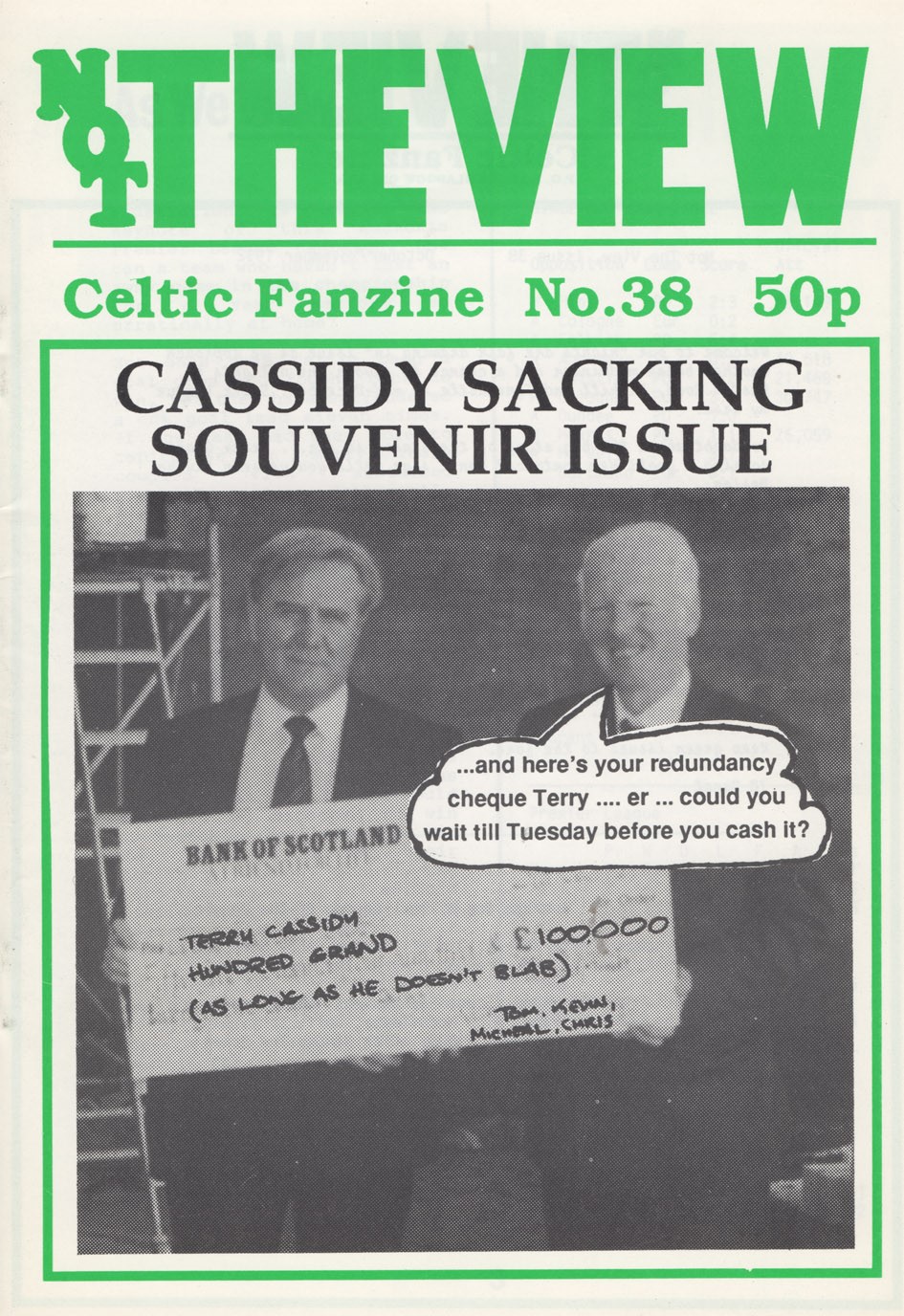
Terry Cassidy
Terry Cassidy, like his namesake Hopalong, finally bit the dust around the turn of the year, while Doc Kelly blew smoke from the barrel of his sixgun having demonstrated once and for all that there wasn’t room enough in Walfridsville for more than one gunslinger.
The nearest I ever got to the man Cassidy was when I attended a Save Our Celts Rally in Shettleston which he attended as a representative of Celtic FC to listen to the concerns of ordinary supporters about the fate of the football club they supported and he didn’t.
I came not knowing what to expect but prepared to listen and give Cassidy the benefit of the doubt. Having watched and listened to a succession of smug platitudes, half-baked excuses and some outrageously rude behaviour from Cassidy towards some other guests of the Save Our Celts campaign I left convinced that he was a grave liability to Celtic FC and would do for the fans what an Italian bed did for Mo Johnston’s looks.
Why the Celtic board had felt the need to employ such a person as Chief Executive was a question which sprang to mind, quickly followed by, “If HE got the job what on earth must the other candidates at the interview been like?”
Clearly the board had finally come to the conclusion that they themselves were incapable of securing the post-Taylor financial future of Celtic (an admission of failure which would have had honourable people scuttling for the exits with resignations clutched firmly in their clammy hands) and were now relying on a Chief Executive to drag them into the 21st Century. Mission Impossible – finding the necessary cash to provide a stadium fit for modern football and quality players to play in it – was given to Cassidy.
His approach to his task, and the carnage it left in his wake, had already passed into folklore almost before he’d left, but what were his achievements over the 22 months of his tenure?
We were told that retail sales of unsponsored Celtic strips, tea mugs, table mats and soap on a rope had increased substantially, but this had to be offset against the disastrous Celtic Family card scheme, which cost a fortune to set up for virtually no return whatsoever.
In any case, selling more official Celtic rock, sponges and ladies briefs, while in the process doing his utmost to sink the pirates, turned out to be no more than a piss in the ocean in terms of supplying the kind of money being bandied about as being necessary to fund any kind of stadium development far less Cambuslang Disneyworld.
Although sales of season tickets increased, revenue was lost through successive reductions in the capacity of the stadium following the Taylor Report and UEFA regulations concerning crowd safety for big matches.
The club was put on a more business-like footing through the creation of new posts at middle management level, but at the cost of alienating some of the sponsors at the time.
Executive Club members wee reportedly unhappy at the antics of Cassidy as Chief Executive and his paymasters on the board.
The net result of all these commercial activities, plans and schemes in terms of attracting much-needed revenue to Celtic would be revealed in the annual accounts, but it was clear that Celtic was sliding further and further into a financial quagmire.
Cassidy was a ready made scapegoat for the board’s lack of vision, direction and financial ability.
Kevin Kelly was quoted as saying that the reason for Cassidy’s sacking was that the board, “… felt that WE (our emphasis) had not made as much progress as we had expected during his term of office.”
Kevin neglected to inform us, while he was at it, of the progress made off the field during his own term of office.
David Smith (who he? – ed) was to be the next in line for the chance to raise dosh for the Cambuslang venture, which the board was still insisting would still go ahead regardless of Cassidy’s dismissal
We waited with everything akimbo to see how long he would have to perform his financial miracle.
 ntvcelticfanzine.com
JBB,
I remember years later having a conversation with someone who was big Billy’s secretary around the time that Terry Cassiday was Chief Executive and she said that, as you say, he did put them on a more business like footing.
She said that a lot of the staff were happy with the changes he made to introducing a raft of policies and procedures that made their life easier.
She did tell me that she used to help out in the ticket office when the season tickets were being renewed. In those days, it was mostly cash payments and before Cassiday came along, the system was that the money taken from supporters paying for their tickets was put underneath their right or left butt cheek and when it got too uncomfortable to sit, they were replaced by someone else.
I somehow don’t think they would have had that written down in a procedure manual to show the auditors!